

Hemorrhoids That Require Surgery

When dealing with hemorrhoids that require surgery, the proctologist (the medical specialist dealing with anorectal health) will refer you to a colorectal surgeon – another medical specialist specifically trained to address anorectal conditions through surgical interventions.
Your proctologist will possibly perform post-surgical care and should stay an active member in your care throughout the surgery and the recuperation time. The proctologist will discuss with both the colorectal surgeon and the patient what surgical treatments or operations will fit your case.
As long as you consent, the colorectal surgeon will give you recommendations and specific instructions before the actual surgery and what you should do at home to prepare your body for the operation, with requirements for self-care before the surgical treatment and what you can get from the surgery.
While several surgical procedures can be performed on an outpatient footing, where you go home on the same day of the operation, each surgical operation typically prohibits at least several substantial activities for up to a few weeks.
You should also get medical predictions on how much tenderness will be implicated, and directions for relieving the pain, swelling, colorectal bleeding, and other typical side effects. Either the colorectal or your proctologist, or maybe both, would like to examine you a few days after the operation to make sure that your recuperation is progressing positively and no side effects have developed.
You should keep in mind that surgeons are not distinguished by name as to what kind of surgery they specialize in, so you should feel free to inquire about their skills and experience concerning the surgical operation prescribed for your condition.
As well, your general doctor and, at this part, proctologists are great sources, as they are well acquainted with surgeons and their special field, and their reputation, in your community.
Most medications depend on an organization of triage, or levels of importance based on the degree of severity of the hemorrhoid. Because of this, waiting periods can range from a few days, in the case of specifically serious hemorrhoids that need to be cured right away, to several months in the instance of reduced serious cases.
Having an appointment for any colorectal surgeon can take up a few months, but visiting your general doctor should take no more than maybe a few weeks, and no more than a couple of weeks more for a proctologist.
Because of this, it is essential to be honest as to not only the degree of the hemorrhoid but how much they are affecting your everyday living. This is not the proper time to keep a firm upper lip and downplay your conditions so as not to be seen as a condition, but to make sure that all medical practitioners know how much hemorrhoids are troubling your work, your peace, or your relationships with people around you.
If they are fully aware of your condition, they can make a better diagnosis as to your priority and expedite treatment periods or give transitory treatments as suitable to you to receive the highest treatment that you need.
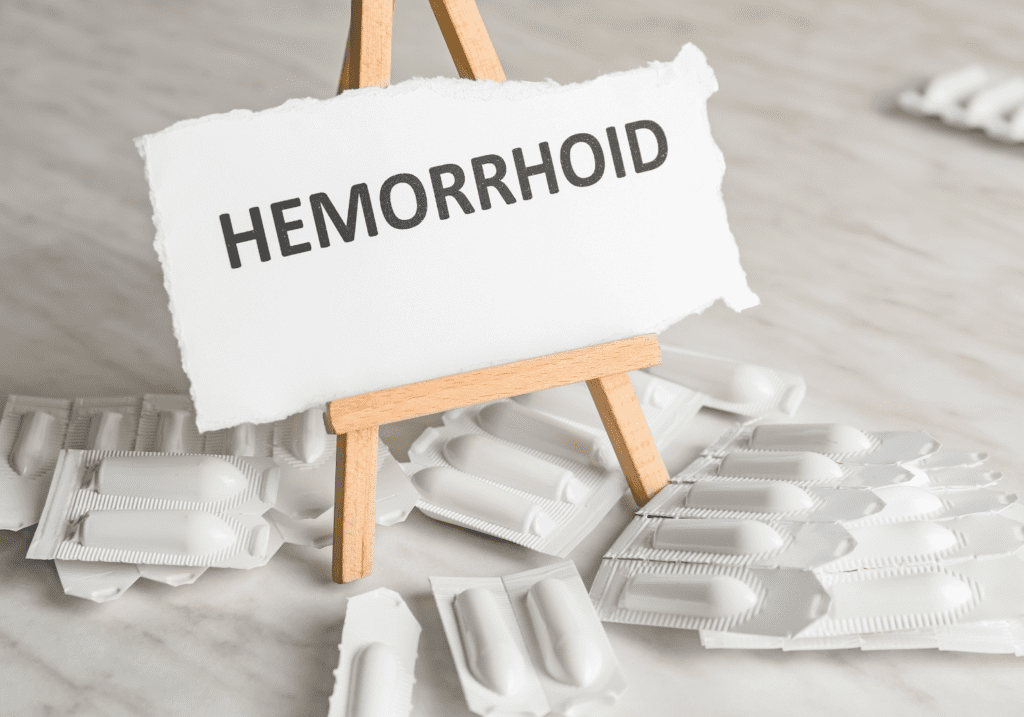
Surgical Treatments For Hemorrhoids
There is a method surgeons perform to verify what kind of surgery to perform on a patient’s hemorrhoids.
Sclerotherapy
If hemorrhoids are present, but they are not yet protruding from the opening of the rectal opening, there’s a great chance they are mild hemorrhoids that can be cured surgically using a simple injection into each hemorrhoid. The surgical treatment you follow is very familiar to rubber banding, but rather than getting a band, they inject a chemical that will kill the hemorrhoid.
This treatment is called sclerotherapy. This treatment works by injecting a chemical into the hemorrhoid that will block vessel engorgement and tissue inflammation that causes the hemorrhoids.
If the chemical injected is phenol, then the goal of the surgery is to regulate rectal bleeding.
If the liquid injected inside the hemorrhoids is a salt solution, the hemorrhoid will usually decrease to its normal shape and size.
Hemorrhoid Cauterization
Surgical operation using cauterization includes searing the hemorrhoid with an electrically charged wire. This is used on mild and small hemorrhoids, but rather than injecting, they cauterize.
Infrared Coagulation
Hemorrhoids that do not protrude, or which draw back after protrusion, can be treated using Infrared Coagulation commonly known as Laser Coagulation Surgery.
Rubber Band Ligation Hemorrhoid Surgery
This is the simplest surgery. It is a rubber band ligation that can be fairly weird but effective.
This type of surgery generally works by tying a strong latex rubber band around the internal or prolapsed hemorrhoids that block the blood flow to the entire bulge. In a few weeks, the hemorrhoid will naturally weaken, eventually leading to necrosis and its subsequent detachment.
It is quite worrying to think of blocking circulation to a body part, but when performed by a surgeon this hemorrhoid surgery is by far the safest, simplest, and most effective prolapsed hemorrhoid surgery.
Pain can be extreme if the hemorrhoids are too near the nerve band around the rectal area, so remember to tell your surgeon if you are feeling pain during the ligation.
This kind of surgery is best on medium-sized hemorrhoids, as there must be enough skin mass for the rubber band to block.
Hemorrhoid Cryotherapy
This surgical treatment is used when the hemorrhoids are in the state before they reach the level of being outside the rectal opening and for most people, even when the hemorrhoids are showing. The surgery includes the hemorrhoids being deep frozen, then left to dry up and die, very likely to the outcome of the rubber band ligation. Pain lasts up to a couple of weeks.
The Stapling Hemorrhoid Surgery
This surgery is also known as Hemorrhoidopexy and is used for internal hemorrhoids that have prolapsed.
Artery Ligation Surgery
This surgical treatment is a non-conventional technique to the more common hemorrhoidectomy, and also an appropriate alternative for all types of hemorrhoid surgeries. Using a specific treatment using ultrasounds, the surgeon determines which arteries are giving blood to the hemorrhoids and then sews up the blood artery closed just above the hemorrhoids. The outcome of this surgery is fairly effective.